NASF’s committee structure enables state foresters to serve as subject-matter experts and influence national policies and partnerships. Learn more about the association’s five standing committees below:
Wildland Fire Committee
Chair: George Geissler, Washington
Oversees implementation of Cooperative Fire Programs and develops new policies and tools to allow for more effective and safe fire suppression and management. Email the NASF Wildland Fire Committee.
It’s always wildfire season somewhere in the United States. More people in fire-prone landscapes, high fuel loads, drought, and unhealthy forest landscapes are among the factors that have led state foresters to identify wildland fire as a significant priority issue in their Forest Action Plans.
State foresters are responsible for wildfire protection on nearly two-thirds of America’s forested lands and provide critical resources to the federal government and local entities. State forestry agencies also support prevention and mitigation efforts to reduce the risk of wildland fire.
Wildfire must be treated as a national land management issue. Hotshot crews, fire fighting equipment, and other valuable resources are shared among states, the federal government, and other agencies countrywide, year round, and across landscapes fragmented by varying ownership and political jurisdictions.
The National Cohesive Wildland Fire Management Strategy (“Cohesive Strategy”) is the roadmap for interagency wildland fire management across the country that allows diverse stakeholders to work collaboratively using the best science to make meaningful progress toward three goals:
Resilient Landscapes
Fire Adapted Communities Safe
Effective Wildfire Response
Forest Markets Committee
Chair: RICK OATES, ALABAMA
Seeks to maintain and expand markets for the broad array of forest products, including traditional wood products, bioenergy, and ecosystem services. Email the NASF Forest Markets Committee.
State and privately owned forests make up nearly two-thirds of the nation’s forestland and provide essential economic, environmental, and social benefits to society as a whole. These benefits are maximized when forests are actively managed, but in order for management to occur, diverse and ample markets for wood are needed. Wood markets allow private landowners to generate the necessary revenue to not only retain ownership of their forestland and keep forests as forests, but also to manage it in ways that benefit all Americans.
Highly diverse wood markets also increase options for forest management on state and federal lands. When markets are capable of accepting and processing all kinds of wood, land managers are empowered to remove undesirable growth that curbs forest productivity and fuels wildfires.
Forest Resource Management Committee
Chair: Marcus Warnke, South dakota
Addresses issues related to private and public forest lands management, including landowner assistance programs, taxes, water resources, and related federal programs and legislation. Email the NASF Forest Resource Management Committee.
The primary purpose of active forest management is to promote the health and productivity of forests while ensuring sustainability. Poorly managed forests are generally disease- and pest-ridden, fire-prone, and overgrown. Forest threats like disease, pests, and wildfire, know no boundaries and easily spread across ownership types to negatively affect healthy forests. Active management makes our nation’s forest more resilient in the face of these threats, allowing forests to remain healthy and productive.
Active forest management can include practices such as timber harvesting, stand improvement, tree planting, fire suppression, prescribed fire, weed control, and pest trapping or spraying, and forest health monitoring.
The benefits of healthy forests are enormous: a stable supply of wood, clean drinking water for over 68,000 communities, millions of acres for recreation, rural job opportunities, critical wildlife habitat, reduced wildfire risk, and so much more.
Forest Science and Health Committee
Chair: Greg Hicks, North Carolina
Addresses issues concerning forest health and forest sustainability, including invasive species, forest inventory and monitoring, and forest research. Email the NASF Forest Science and Health Committee.
More than 80 million forested acres are at risk of insect and disease damage, according to the latest assessment conducted by the USDA Forest Service. Damage to our nation’s forests puts the health and livelihoods of Americans at risk, and for this reason, the proper management of our forests is a critical national priority.
Combating these pests and pathogens requires coordination among state and federal natural resource agencies, private forestland owners, and private and non-profit forestry organizations to address these threats to the health and productivity of America’s forests. State forestry agencies and the USDA Forest Service are helping to slow the spread of invasive species, restore damaged habitats, and educate the public through the Forest Health Management Program on Cooperative Lands program.
State forestry agencies are also improving forest health through increased communication and coordination with landowners. Private and family forestland owners hold more than 60 percent of all the forestland in the United States, but only four percent of these stakeholders report have written management plans.
State Forest Action Plans have strategies focused on outreach and support to private forest landowners, including management strategies for enhancing the sustainability and profitability of forests. State forestry agencies also deliver expertise and planning assistance to private landowners through the Forest Stewardship Program, as well as ownership transition assistance through the Forest Legacy Program.
About 39% of the nation’s tree cover is found in urban and suburban communities.
Urban and community forests are made up of the trees that line your neighborhood’s streets, shade your yard and define the community green spaces you frequent. These forests provide Americans with a range of ecosystem services and can even help mitigate the effects of extreme temperatures. What’s more, their value grows year after year, making planting and caring for community trees a truly wise investment.
Trees make jobs.
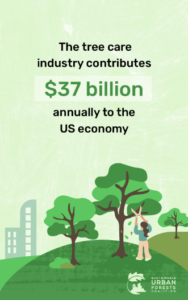
The urban forestry sector directly contributes $37 billion annually to the U.S. economy in part by employing more than 500,000 people nationwide.
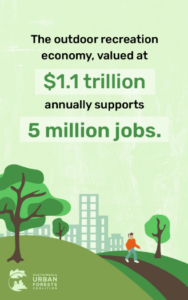
Graphic courtesy of Sustainable Urban Forests Coalition.Graphic courtesy of Sustainable Urban Forests Coalition.
Like working forests in rural landscapes, trees in all communities are working hard every day to provide valuable benefits. These resources improve the value of other types of infrastructure and offer flexible and cost-effective solutions to a wide variety of infrastructure-related issues.
Trees in communities reduce energy use for cooling and heating by 7.2% nationally, saving consumers more than $7 billion. These benefits support national self-reliance and help businesses and households save money.
Urban forestry investments can also help address stormwater runoff as streets are being repaved, protect water quality while relieving pressure on aging wastewater utilities, and serve as sound barriers between communities and highways or railroads to improve safety and quality of life. Annually, $73 billion in benefits are delivered to society by mitigating air pollution and stormwater runoff.
Trees also help mitigate extreme weather and disaster impacts while protecting surrounding built infrastructure, which saves taxpayer dollars and preserves resources for national priorities. The value and benefits grow year after year, making planting and caring for community trees a truly wise investment for the public and private sector alike.
Furthermore, trees also offer significant economic value to homeowners and real estate investors by boosting property values. Homes with trees in their yard enjoy property value increases of more than $30 billion, annually, in the US. A tree-lined neighborhood attracts new residents, businesses, and tourists, further fueling local economies.
NASF works with many national partners to conserve, protect, and enhance America’s urban canopy including:
USDA Forest Service – Urban and Community Forestry Program
Since its expansion under the Cooperative Forestry Assistance Act of 1990 (CFAA), the Forest Service’s Urban & Community Forestry (U&CF) program has provided technical and financial assistance to promote stewardship of urban forests in communities of all sizes across the country. The program is delivered in close partnership with State Foresters and leverages existing local efforts that have helped thousands of communities and towns manage, maintain, and improve their tree cover and green spaces.
Alliance for Community Trees
A unique program of the Arbor Day Foundation, Alliance for Community Trees, is a premier network of community-based organizations dedicated to improving the livability of their towns and cities through planting and caring for trees.
American Forests
NASF partner organization American Forests advocates for the protection and expansion of America’s forests. Since 1990, the organization has planted more than 45 million trees. The work of American Forests is guided by science: choosing the right mix of trees for particular locations, the best trees to act as windbreaks or to filter water, the trees that will provide wildlife habitat, or are most suitable for city streets and parks.
Arbor Day Foundation
NASF partners with the Arbor Day Foundation (ADF) on the long-standing Tree City USA program, which helps America’s communities enhance the extent and health of their urban forests. The Arbor Day Foundation, in cooperation with NASF members, administers an array of complementary programs, such as Tree Line USA and Tree Campus USA, designed to further advance urban forestry programs nationwide. NASF and its members support and work with ADF on many other programs including the annual Partners in Community Forestry Conference.
International Society of Arboriculture
The International Society of Arboriculture works worldwide to promote the professional practice of arboriculture with an emphasis on education, using technology, and conducting research.
Sustainable Urban Forests Coalition
NASF participates in the Sustainable Urban Forests Coalition (SUFC), an alliance of foresters, arborists, city planners, non-profit leaders, and others who work together to advance policies that develop the capacity for long-term management of urban forests, trees, and green space. SUFC advocates for programs that provide multiple benefits to the public; address issues at the landscape level and across jurisdictional boundaries (all lands approach); facilitate interagency coordination to protect urban forest health; advance science and research; promote urban trees and forests as green infrastructure; and support local initiatives to maximize impacts for every dollar invested.
Vibrant Cities Lab
Vibrant cities cultivate thriving urban forests that boost public health, safety, sustainability, and economic growth. To this end, the Vibrant Cities Lab hosts a searchable, curated library of research papers, guides, ordinances, and other resources deemed most helpful in making the case for urban forestry in your community.
Communications Team
liaison: Tee Jay Boudreau, Rhode Island
Promotes healthy, sustainable forests across America by delivering NASF’s messages to its members and partners, as well as the public, federal policy makers, the White House, and Congress. Email the NASF communications director.
Policy Team
liaison: Matt McCombs, Colorado
Provides guidance to the Executive Committee on setting legislative priorities and strategies for the association. Email the NASF policy director.
Your state’s Forest Action Plan includes in-depth analysis of forest conditions and trends in your area. Collectively, the states’ Forest Action Plans make up a roadmap for forest management on a national scale.